Monday, January 24, 2011

Northeast Rim in January

Sunrise from Southeast Rim of the High Chisos
The weather forecast was delightful, and the moon would be full.  In two weeks the trail would be closed because of the peregrine falcon nesting season, so I decided on the spur of the moment to stay overnight at Northeast Rim in the High Chisos.  

I ditched my faithful 25-year-old Jansport backpack when I had my yard sale back in Maine, since it was no longer comfortable on my more ample body, and adapted my lovely REI daypack to carry my new Big Agnes 15 degree sleeping bag, the air mattress, and my fat warm jacket.  I borrowed a tent from the Rio Cache at the park, spent an hour struggling with it in my living room so I knew how to set it up, then decided I'd leave it behind because I simply could not jury-rig it onto my daypack with the other stuff.  The chance of precip was nil, so I figured it wasn't a huge risk.

My daypack adapted for an overnight trip

Teal Jansport on Free Pile (sob!)
I learned my lesson from last year's day hike to the South Rim, when I returned dehydrated.  I brought lots of water (man was it heavy) and made myself drink every half hour or so.  I've always been a slow hiker, even when I was young, thin, and hiked or backpacked every weekend.  But now that I'm, er, a woman of a certain age, it was just a little harder to go from 5400 feet to 7400 feet elevation with enough stuff hanging off my pack to make me look like a bag lady. 

I went up the steeper Pinnacles Trail, since I am convinced that the Laguna Meadows Trail is about twice as long as the official markers say, plus I really wanted to see a Mountain Lion.  Many people have had one appear right in front of them, then perch itself serenely on a rock for a photo op on this trail.  I kept looking.  Once again, no luck. 

Mexican Jay
 I did hear the spotted towhees singing, which was a version of the Eastern Towhee's "drink your teeeeeaaaaa..." that I hear in Maine.  Even saw my first juncos of the season, about eight of the gray-headed type.  And I discovered that the noisy Mexican Jays can warble.  Several were close to me and their warbles were soft, quiet, and lovely. 


I met one of our volunteers about halfway up Pinnacles.  What took me an hour and a half took him about 40 minutes, since he was traveling light and kind of jogging up.  What an animal.  I finished my snack and my sips and trudged gamely upwards. 

Arizona Cypress
I converted about a half pound of apple, cheese and water to body mass during lunch at Toll Mt. - the site of The Worst Night of My Life (see Feb 2010 blog) - and continued along the Boot Canyon Trail. 

Boot Rock
Boot Rock was backdropped by the desert hills and the Sierra del Carmens, and I soon entered a lush canyon of relict trees from the era when the entire area was more temperate and wet.  Huge Arizona cypress, with their cedar-like bark and tight gray-green cones loomed high, along with large oaks of various species, some evergreen, many sporting brown or orange deciduous leaves long dead, but still reluctant to let go.   This is the place to be in summer when the heat bakes the desert below and makes climbing an exercise in masochism.  But this was winter, and my goal was a few miles away.


   Last April, there were many slimy pools of water in the drainage of Boot Spring, but today - thanks to our drought - there was only one.  And perched on a branch over this slime pool was a little bird I first thought was a ruby-crowned kinglet.  But a closer look revealed it was a flycatcher, and it would fly down from its perch to snap up one of the numerous bugs over the pool, and return to await another delectable morsel.  It exhibited a frizzy crown, and pumped its tail slowly up, then down.  When I examined the photographs on my Nikon's screen, I realized it had a strange looking beak.  Hmmm...


Mystery Flycatcher
There was also a canyon wren at the pool, and after a few minutes chasing bugs and butterflies he hopped back up the rock and gave me two bars of his exquisite song as he left.  The first time I ever heard a canyon wren was in the Havasu Canyon of Arizona, and I thought it sounded like a child's flute with a stem that you pushed in so the notes kept descending.  Paul Winter incorporates this distinctive song into his "River Run" composition on the "Canyon" album.  It is perhaps the most representative sound of canyon country.

Canyon Wren
I ws at camp in NE4 by 4:45 p.m., nearly 8 hours after I left.  (I allow a mile per hour of backcountry hiking - always have.  Gives time for birding, looking at rocks and plants, taking pictures, and catching my breath.) The moon was already up but couldn't be seen because of the haze at the horizon, but in no time it was glowing nearly full over the rosy landscape below.  My my my.  I couldn't have improved on it one bit. 


I walked along the SE rim where the views were even better, and watched as the last of the sun touched the soft hills below.  The sun set behind a peak which cast its shadow far into the distance, and even onto the haze above the horizon, as if it were some solid object floating in the sky. 


Shadow of a peak rising above the eastern horizon at sunset


My campsite in NE4 was sheltered, which was ideal for someone who had brought no tent.  I dug out my stuff from the bear boxes and fired up the Pocket Rocket stove.  I put a cup of Minute Rice in the boiling water, and let the packet of Indian sauce with peas and mild chunks of cheese warm in the steaming rice.  Then I poured and mixed for a tasty meal.  It was too much for one person, so I put the rest away for breakfast.  After reading "Apollo 13" for awhile, I crawled into Big Agnes and slept under the stars cowgirl style.  I kept reading, my Black Diamond headlamp providing great light until I was sleepy.

I never sleep well on the ground, and though I wasn't freezing, I wasn't completely toasty either, even though the temps were probably in the mid to upper 30s.  (It had been below freezing, so I was lucky.)  The moonglow looked green, perhaps because the trees lent a certain color to the usually silvery light, or perhaps I just imagined it, but it was greatly welcome.  I get claustrophobic when I can't see my hand in front of me. It was windless until probably 2 a.m. when a gentle breeze arose.  I pulled the sleeping bag over my head.  The long dark hours passed in a state of dreaming and semi-wakefulness, and I nearly missed the sunrise.  So I hurried into my boots and made it to the viewpoint as the sun peeked over a hazy landscape. 

Standard-issue pinyon pine framing the foreground

Breakfast was leftover Indian food and rice, and Emergen-C powder in my water bottle for vitamins and electrolytes.  I had brought a teabag of Lapsang Souchong but didn't feel like cleaning out the cooking pot for the water, so I ate some Ghiradelli bittersweet chocolate chips for my caffeine hit.  Packed up camp, and off I went. 

I studied the topography below from the Southeast Rim, thinking of the astronauts who could recognize the topography of the moon and all its named landmarks, and wishing I could do the same with what I saw below.  I didn't have a big enough map with me, but figured I would work harder at it next time.

Dusky Flycatcher
Before I knew it, it was one p.m. and I was sitting on the trail overlooking the slime pond at Boot Canyon again, hoping to spot the crazy flycatcher.  The canyon wren was back, even more beautiful in the filtered light.  Then I heard "Wheep.  Wheep."  The flycatcher returned, darted for bugs for awhile, then flew away.  At least three pine siskins took up watch in the nearby oak. 

As pleasant as it was, I needed to move out, and soon met Joseph the park packer at the corral in Boot Canyon.  He and six mules had been bringing up "water logs" and metal poles for tripods to move rocks so that more water diverters could be put in place.  There are dozens of these on the slopes to keep water from eroding the trail.  If there had only been an extra saddle, I could have hitched a ride down.

Lunch again at Pinnacles, this time sardines and crackers.  Sardines are my emergency larder, but they are excellent protein when working hard.  I like to save them for the last meal before home, since the empty cans are smelly and need double-bagging in freezer bags.  Don't need no hungry bears following me. 

Down Pinnacles, again hoping for a Mountain Lion.  Again skunked.  But I was exhausted, my feet hurt, shoulders sore (though my pack was 10 pounds lighter I think), and I was anxious for a shower.  The last half mile is always the longest.  But thanks to plenty of drinking water, the next day I was up and at 'em - energized and hardly sore at all.   And can you guess which was the first picture I looked for when I downloaded the photographs the next day?

Why, that crazy flycatcher!  Three bird experts hashed it out and decided it was a Dusky Flycatcher, definitely one of the look-alike epidonaxes.  But that bill, it was definitely put on sideways.  The little guy adapted his bug-catching style just fine, thank you. 
Closeup of crazy flycatcher's sideways bill
Just like I adapted to get myself up to Northeast Rim for a lovely moonlit night.

All text and photographs on this blog are copyrighted by Cindy McIntyre and may not be used without permission.


Tuesday, January 11, 2011

Ice Fog in the Chisos 1-11-11

Casa Grande
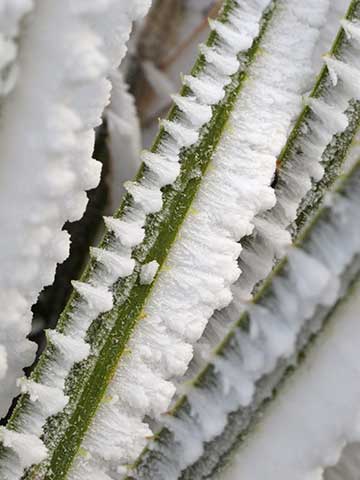
When I couldn't see the mountains this morning from my front window, I knew something glorious was happening up there.  In Panther Junction it was in the 20s, and combined with little droplets of moisture up higher, hoarfrost would surely be the result.

Road to the Basin

Sure enough, near the Lost Mine Trail it was at its peak - as if snow had settled on every leaf and blade.  


Just beyond, as the road dipped down, the sun was shining in the Basin.  But here the wind chill froze me to the bone.  I knew this wouldn't last, and by 10:30 - as the sun warmed the thickly coated trees - the wind began knocking off the icy shards. 


White tendrils of fog crawled down little creases in the mountains, while chunks of it were blown quickly through others.  


As the vista cleared, it became apparent that this ice fog only affected a fairly small segment of the Chisos, mostly alongside the road it seemed, perhaps because of the way it funnels the wind through the pass.  


High up on Casa Grande, the muted golds and siennas of the fall oaks appeared to be untouched.  There had been a coating of frost in the Basin, judging from what was on car windshields, but it seemed that the ice fog with its transformative power preferred to linger only on certain slopes, at certain elevations.  

Trees higher up, at base of Casa Grande, appear untouched
Pinyon pines seemed to grab onto this ice most tenaciously, probably because of the amount of surface area each needle offered it.  


Sotol and grasses appeared to be sheared flat at the tips, and a close inspection revealed that the points were indeed still there, but the ice rime just built up and out and was shaved flat by the wind.  


A very large orb spider web was collapsed by the ice, but strong enough for its main shape to hold up under the onslaught.  


Fog and sunlight varied second to second, altering the landscape, highlighting first this century plant, then that crag, and then hiding them both.   


Last year my buddy Shanna was enraptured with the hoarfrost that decorated the landscape during a similar event, and she made a video of the beauty she found.  What I remember most is the look of wonder captured in her eyes.


Indeed, who wouldn't be bewitched by such a transformation?

The Window from Lost Mine Trail parking area

Thursday, December 30, 2010

Census for the Birds


Vermillion Flycatcher male


I spent about five months in 2009 and 2010 helping the U. S. Census Bureau count people for the 2010 tally.  I spent the last two days counting birds for the 111th annual Christmas Bird Count.  About a dozen of us covered two circles fifteen miles in diameter here at Big Bend National Park, one in the Chisos Mountains area, and the other in the Rio Grande Village area.  People came from Austin, Las Cruces, NM, and other places to help us "locals" with this important (and very fun) duty.

The CBC began just as the country was getting the idea that indiscriminate killing of birds for fashion and "sport" was immoral, causing the drastic decline and sometimes extinction of innocents.  From the National Audubon Society website:

Prior to the turn of the century, people engaged in a holiday tradition known as the Christmas "Side Hunt": They would choose sides and go afield with their guns; whoever brought in the biggest pile of feathered (and furred) quarry won.  

Beginning on Christmas Day 1900, ornithologist Frank Chapman, an early officer in the then budding Audubon Society, proposed a new holiday tradition-a "Christmas Bird Census"-that would count birds in the holidays rather than hunt them.
Bushtit in pinyon pine
The count helps gauge the health of bird species and to determine if conservation measures need to be implemented if a precipitous decline is noted.  It also tells us which birds are expanding their range and population.  

In Big Bend, many of us have noticed a decline in the quantity and variety of birds this fall, most likely due to the extremely dry conditions which cause lack of food.  For instance, last year there were juncos all over the place - most of the color varieties were frequently seen on the Chisos trails.  This year I've not seen a one.  These guys rely on seeds and they will jump on grass seed spikes and bend them down, running their conical beaks along the stem to strip the seeds.   No rain, no seeds.
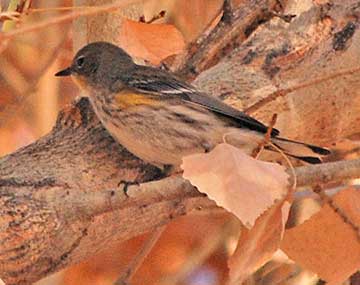
Butterbutt (Yellow-rumped warbler, Audubon's variety)
The mechanics of being "citizen scientists", as Audubon calls us, are simple.  You see a winged shape zip by and you try to identify and tally it.  If it hides, you "pish" and hope it's one of the curious species that responds by popping out to see what the fuss is about.  (Pishing, for you non-birders, is when you go "pwsssssh pwsssssh pwsssssh" repeatedly, which is supposed to be an alarm call or possibly just an annoying noise that birds can't resist.  I was taught as a kid to make a squeaky noise by kissing the back of my hand, and I also resort to that.  
Black-crested Titmouse
Too much pishing is considered harassment, so one must be discriminating.  (And woe to those who use taped bird calls to lure in the target - this adds stress to birds thinking an intruder has arrived and must be fought off.)  Most birds ignore us anyway, so we hope for that one little glimpse to tell us the bird is a black-throated sparrow instead of a white-crowned, or a black-tailed gnatcatcher instead of a blue-gray.  We look for that flash of tail of a soaring bird a quarter mile in the air that tells us it's a red-tailed hawk, and listen for that twitter in the bushes that tells us the bird we never see is a verdin. 
Black Phoebe
I'm amazed at how good some people are at birding.  They have better eyes than mine, and better memories, and can identify quickly a bird I struggle with.  (Oh those pesky sparrows - so many shades of brown!) That's why it's good to bird with others - yes "bird" is a verb - even though it's an activity I often do alone, and find enormously relaxing.


Of course, we all went down to Daniels Ranch to see the illustrious Tufted Flycatcher, but even though we got there minutes after the sun struck the cottonwood trees, only a few people there before us saw it before it went elsewhere.  It did get on the Count, though - woo hoo for Big Bend!  
Looking for the elusive Tufted Flycatcher at RGV- it was shirtsleeves weather a couple hours later
Why do people "bird?"  I guess it's part of the hunting instinct our ancestors needed to survive, ours being the "thrill of the hunt" to find, not to kill.  It also fulfills a need in some of us to "collect" - and many birders have a Life List.  (I won't even mention those who spend tens of thousands of dollars and petroleum products chasing rare birds for their lists.  This may be a type of Obsessive Compulsive Disorder, or maybe just somebody who can afford to do what the rest of us would love to do if we didn't have to pay our bills.)  
Ruby-crowned kinglet showing his ruby
But mostly, I think it's that we appreciate beauty, and birds are indeed beautiful and even mysterious.  They migrate by means even scientists can't fathom, and return to the same bird box the following spring.  Mystery!  Even the piercingly squeaky calls of the starling are, in their own way, marvelous, no matter what one may think of the species itself.  
Rufous-crowned sparrow
I pity the poor souls who are not moved by birds, who do not thrill at the spring song filling a deciduous woodland, or marvel at the glistening colors of a hummingbird.  When I did the people Census in Maine, I noticed a great many people had bird feeders in their yards.  Birdwatching is one of the top hobbies in this country.  In the same way ladies of fashion gave up their hat feathers a century ago to save the egrets who were killed on their nests for their plumage, I think the backyard birder today can be motivated to support conservation measures that will help "their" birds survive.  The Christmas Bird Count is one way to do this.
Black vulture

Friday, December 3, 2010

Sun Dogs and a Sun Pillar

Sun Dog on Right of Sun
 A pair of sun dogs flanked the setting sun this evening, formed by ice crystals in the cirrus clouds.  


I photographed this from the Persimmon Gap Entrance Station where I work, just as I was closing up.   This shows the panorama of their relationship to the sun.

Sun Dog to left of sun
 The red color of each sun dog faces the sun.  

Sun Pillar behind the Corazones at sunset
 A half hour later, a sun pillar decorated the orange clouds of sunset behind the Corazones.

For the technical scoop on this atmospheric phenomenon:

Monday, November 29, 2010

Tufted Flycatcher

I would not have known about this rare bird at Big Bend National Park if a fellow who worked in Southern Florida hadn't come through my entrance station on Friday to tell me he drove 30 hours straight to see it after it was posted on the North American Rare Bird Alert.  It was number 731 or something like that for this young man!  Evidently this is only the third US sighting ever of this Mexican bird, as far as I can tell, and the second for Big Bend - the first was in 1991. 

Other people came looking for this addition to their life lists - from Fort Worth, San Antonio, Louisiana...  There was a rumor that a sharp-shinned hawk might have gotten it (gasp!)  But it was still there this morning, first in the open with sun illuminating its cinnamon breast just before I arrived, and then in the shady cottonwoods immediately across from the Daniels Ranch trailhead at Rio Grande Village.  A young fellow from Louisiana located it around 11 a.m., and the San Antonio fellow came running down the trail (bless his heart!) where I was photographing a vermillion flycatcher to tell me he had a "better bird" for me. 

I was entranced by its antics - it darted after its prey faster than any flycatcher I'd ever seen, making sharp turns and quick forays from its perch, then when landing, without fail, gave several sharp flicks of its tail - more like "vibrating" it.  It had a single and double noted call, very soft, very flycatchery.  I even heard the snap of its beak a couple of times as it snatched a bug in mid-air.  Eastern, black, and Say's phoebes were nearby - the first two in the same tree, and the latter by the river. 

It amazes me that people travel so far to add a bird to their Life Lists.  My own list is probably 300 something birds - it's a very casual list.  I've been a birder since I was 9 years old, but I'm not sure I'd travel 30 hours for a bird that made a wrong turn in its travels and landed in the US.  But I feel very fortunate that I've added another rare bird since being at Big Bend (the first the Colima Warbler) and have spent many blissful hours watching birds here - many of them new for me.

Wednesday, November 24, 2010

River Virgins in Santa Elena


 A poem and photo essay
Deep in Santa Elena Canyon
It finally happened.
My turn on the river,
one of the few here
who has not canoed or rafted or tubed
down the Rio Grande.

In Rock Slide
            Which is not grande.  Not now
            at low water,
            diverted upstream by
            dams and irrigation
to a little creek here
at Lajitas, where we put in.

At "metates"

Me up front in gleaming Number 30,
            also a river virgin,
born in Old Town, Maine.
Bud at stern;
on patrol, John and Elaine
in trusty Number 21.

Tricky spot at Rock Slide
            November. 
No wind, sleeveless,
dipping oars quietly
in the low water
gliding
then “running” the little riffles,
            sometimes hanging on rocks,
            good New Balance shoes (also Maine made) soaked.


Darning needles and mosquito hawks
in tandem flight
joined tail to head in love,
webbed wings a glistening escort.
            Bobcat ears twitched. 
            Mexican horses and cows switched allegiance.

Grinding hole at "metates"
Metates and a coiled fossil
lured us ashore,
            jay-blue sky
rimmed by an ancient white seabed
hugging intrusions from a hidden furnace.


By four-thirty, tents, sleeping pads, the required toilet,
cooler, life jackets, table, chairs, day packs
            and an old tire
found their places ashore
where the river
when swollen and grande,
wipes away the landscape.
            Bud brought little round steaks
            bordered in bacon,
            and vegetables and potatoes
            snuggled in foil.


A little wine (Bud again) and he read
Elaine’s favorite poem by
Robinson Jeffers about the vulture
who thought him dead:

That I was sorry to have disappointed him. To be eaten by that beak
     and
     become part of him, to share those wings and those eyes--
What a sublime end of one's body…

Bud asked, “What makes empires collapse?”
I didn’t have an intelligent answer,
            though I thought I should have. 
The incurious stars, the extravagant ribbon of Milky Way
burn over all empires past and future.  Later,
Orion’s Belt peeked through the tent at several
awakenings,
            panning across my reluctant vision.
Apprehensions about Rock Slide
drove my car into a flash flood
but I found an air bubble and
escaped in my dream
so I was not haunted come morning
when life jackets were zipped.


Rock Slide
Elaine and Bud preparing strategy for maneuvering
 I was on the Penobscot once, in Maine,
rafting with my son and nephew
and two fat ladies,
            oars frantically
            rowing air
            as we sailed over treachery.


But with Bud, who knew what to do,
I think woo-hoo
that was easy,
past Rock Slide and Fern Canyon,
            darting black phoebes, sandpipers rocking,
past a watching hawk, a bufflehead
            and Smuggler’s Cave
            onto a shallow reflecting pool,
waving to hikers
at the mouth with Chisos teeth
to the takeout.


We stopped at Castalon
for a V8 and Klondike bar,
a final ritual
and tribute
to the long-awaited seduction.