Wednesday, November 17, 2010
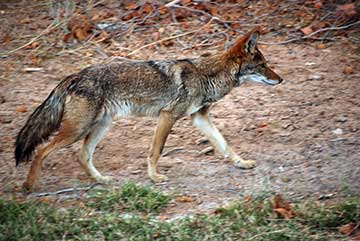
Wile E Coyote
I'm back in Big Bend - will fill you in about the trip, etc. later (after my college classes are over) but I thought I'd just post these photographs of the campground coyote at Rio Grande Village. This guy/gal trotted right through the RV park, and as you can tell, paid me little attention.
Sunday, August 29, 2010
Ninety Miles Around Tahoma - Sept 12
September 12. I am going home.
I hope I am ready.
Eleven miles today and I recall the tortured eleven miles of my second day. Fog muffles sound; the wind does not stir; dew beads on every leaf. My boots are soon soaked. I notice small things now, particularly the profusion of beargrass. I recall baskets I’ve made with cedarbark and dried beargrass; between my fingers the long, narrow leaves are rigid and rough.
I am a bit sad. I do not wish to leave. But I am not a marmot who can hibernate until the snow melts. Nor am I a deer or a hawk or a pipit. I do not belong here any longer. I have accomplished my purpose.
“The hero/ine learns to live in two worlds. This is perhaps the most important teaching of the Vision Quest. One world is sacred, spiritual, eternal. The other world is mortal, material, and subject to change.”
The wet six-mile descent to
It is a significant moment when I come into the clearing at
The day is exactly as it was when I began this journey. Foggy.
“The willingness to be a channel of vision takes great courage and endurance and is not lightly assumed. There will be times when you stumble and fall. Then you will want to crawl away to the sacred mountains. These are times of the greatest potential, when you are looking the dragons square in the eye. Only you know what you have hidden away, growing steadily and surely with its magical roots in your subsoil. As you grow, the vision grows. There is no other way.”
I’ve crossed a hundred creeks, counted a million stars, named all the glaciers, wore feathers in my hair. I’ve been to the Garden of Eden and I was created first. And only. I am part of the cosmic consciousness, knowing that I am in God and God is in me, and I am connected to everything else in the universe. I have had the most profound spiritual experience of my life.
I know that I am an original blessing, not an original sin. I know that I am a co-creator with God and his created. I am an artist. A woman. A mother.
And now I go home.

Tim, Cindy and Ryan McIntyre
20 years ago
Ninety Miles Around Tahoma - Sept 11
September 11. Eight miles to
It is an easy three miles to the
An orb spider has ingeniously hung her web high between two trees, anchoring it on the webs of other, more conventional sisters. Sidelit bugs shoot around it like fireworks, but score no direct hit.
A woodland squirrel is displeased with me for the mere fact of my existence. He chitters like a squeeze toy and signs off with rapid staccato, jerking his body out of sight like a wind-up at Pike Place Market.
By early afternoon I enter the silver forest of
Ninety Miles Around Tahoma - Sept 10
September 10. Tim’s birthday.
I have camp huckleberries in my oatmeal and discover empty plastic bags in the pack. In the place of cashews are mouse turds. The raisins are gone. AND SO ARE MY CHOCOLATE TEDDY GRAHAMS! Evil little bastards. How could they do this to me? I repair the hole they chewed in my Jansport, feeling betrayed. Then I laugh.
I am anxious to leave this place. The trail to
My laundry dries on the back of my pack. It is a challenge to keep upwind of the damp wool socks that smell like mouse turds.
Finally I achieve the ridge with its huckleberries and views.
I must be the only person on the park’s entire
But I know its dangers. The clutter of life will hammer the silence into shards, and my inner peace will be tested. I fear another descent into darkness; I am afraid uncertainty will return. I question whether my peace is illusion that will evaporate with little provocation.
Steven Foster says of returning home, “No one seems to speak your language. You come back, a stranger with a vision. This reincorporation can precipitate a crisis. The true power of the Vision Quest cannot be measured except in terms of the process of reincorporation. You can either let the flame die, or you can decide to begin the vision quest of your life and seek the places where there is fuel to feed your fire. You realize that the only way to communicate the experience is not to talk about the vision, but to live it. Truly, the quest has just begun.”
By mid-morning I am at
It is idyllic here but I grow lonelier. My friend had given me a prayer before I left. It ends this way. “Through the transforming power of My love which is made perfect in weakness, you shall become perfectly beautiful. You shall become perfectly beautiful in a uniquely irreplaceable way, which neither you nor I will work out alone, for We shall work it out together.”
I am alone. And I am not alone.
I have drunk from the
I do not merely complete a circle around this mountain. I travel a spiral, for I return on a higher plane, with greater understanding, a fresher perspective, a deeper love born of intense pain. Yes, my life has had flashes of divine illumination. I remember them now, for I had once felt this way.
It is time to move on. Slash burn haze obliterates the pristine, and I am indignant at the insult to my fellow creatures. Tahoma and I commiserate over our sad state of affairs. A mile and handfuls of huckleberries later, I see
I choose my campsite and go back to
For the first time in 28 hours, I see two-leggeds. A mother-daughter pair, and I am strangely happy that I will not spend the night alone. I pick huckleberries for Tim and Ryan and watch deer play on the dry lakebed. The fawn bursts headlong into the woods then back out again. The ground vibrates as if it is hollow. Mother is oblivious to the antics, and when the baby quiets they touch noses for a long time. I think of my son and me.
Ninety Miles Around Tahoma - Sept 9
September 9. A grouse wakes me, clucking her pleasure at being alive. I can eat huckleberries without leaving my sleeping bag. No one knows I’m here.
By 8:30 in the morning it is warm and still. The meadows are a-hum with bee noise. I watch a bumblebee crawl deep into the narrow indigo gentian. In the process of obtaining food for herself and the next generation, she fertilizes the source of her food so that the flower, too, will bear progeny. However, in doing so, the bee is for a moment vulnerable. Deep inside the blossom, backside exposed, she cannot see her enemy. She risks her life to live. Mitakuye oyasin!
We insulate ourselves from life, fearing the risks. We avoid plunging headlong into the flower, into the depths. My parents did not understand my need to do this “stupid” thing. My mother wrote me and said for my son’s sake I shouldn’t do this. I tell her it is for my son that I must do it. To risk is to grow, and failure is a lesson learned, not proof that I shouldn’t have tried.
I watch the bee. There is harmony in what she does. Do we plan for regeneration of that which we take from nature? We dig, cultivate, harvest, cut, burn, and deposit our waste in Mother Earth. We know it is almost too late to save her, yet we still do it. We do not know enough to respect the rest of creation. We are too busy making money, too busy using up the world.
To each person of strong body, I say “Come. Be alone here for 12 days and nights, and learn what respect means.”
There are sweet huckleberry smells here, mature odors, scents of life and living. Soon the ripeness of decay will permeate these meadows. Snow will follow and will seal away life until July. This is a harsh world. I am privileged to see it at its most fruitful.
I wish to wash my hair, but not in these turbid pools. It would be profane to disturb the tadpoles with chemicals. I will wash it later, in a running stream that will cleanse itself in a few moments of roiling passion.
A helicopter delivers supplies to the ranger station, a rude but necessary intrusion. Two Army Reserve Chinooks come and go all afternoon, removing spent fuel tanks and debris, bringing staples and firewood logs.
A gray hawk circles me. Does God marvel at her, too? Yes, because I see her. God is in me and I am in Him. Or Her. Whoever. God needs us, too. I understand better now.
At 1:30 I leave the meadows and cross an endless suspension bridge over the raging Tahoma Creek. I think of the Jökulhlaups – glacial outbursts that frequently tear through here, moving boulders and uprooting trees. This phenomenon is the reason the park’s West Side Road has been closed, leaving me in greater isolation.
I trudge upward through the forest, and at the top of Emerald Ridge I walk alongside the Tahoma Glacier. It is sheathed in a rough skin of rock the color of raw umber, and pieces continually roll off. The noise is, at times, disturbing. I stay here awhile, knowing it will be the last sun before my descent into the forest.
I read Matthew Fox’s “Original Blessing.” He says the Native Americans define cosmic wisdom as this: that the people may live. “Living implies beauty, freedom of choice, giving birth, discipline, celebration. Living is not the same as going shopping or buying, nor is it the same as making a nest in which to escape the sufferings of one another. Living has something to do with Eros, love of life, and with the love of others’ lives, others’ right to Eros and dignity.”
Black Elk, an Oglala Sioux, tells about the ritual of the sweat lodge, a rite of purification and prayer. Within a womb of willow branches and blankets, the Indian people gather to pray. Water is poured over hot stones and steam brings forth impurities from the body.
When the central altar is constructed, where the heated rocks will be placed, there is prayer. “O Grandfather and Father Wakan-Tanka, maker of all that is, who always has been, behold me! And you, Grandmother and Mother Earth…we have come from You, we are a part of You, and we know that our bodies will return to You…I think of Wakan-Tanka, with whom our spirits become as one. By purifying myself in this way, I wish to make myself worthy of you, that my people may live!”
The ritual of the sweat lodge, inipi, is like a vision quest. There is separation from the real world, a return to the womb and its darkness, a cry for help (“We wish to live again. Help us!”), and rebirth into the Light.
I reach the South Puyallup Camp and find it as dark and dismal as its reputation. Nearby on a damp cliff are stripes of columnar basalt, honed as if by a carpenter’s plane, evenly serrated and stacked. Some of the columns lie shattered in the ferns, reminiscent of Greek ruins.
I realize with dread that I will be alone in this godforsaken place. The closest person is the ranger at Indian Henry’s, four miles, two ridges, and a suspension bridge away. I set my sleeping bag on a ledge over the river, with barely room to stretch my legs. Evil spirits are about, and I hunker in my sleeping bag wondering if a bear will get my food. I tell God I don’t like it here, that I am just a bit afraid, but I know “She’ll be all right.”
The rush of the impatient
I am near the birthplace of the river that flows through
I spend an uneasy night beside this significant river.
Ninety Miles Around Tahoma - Sept 8
September 8. Tim and Ryan wait for me at
We go to
It is cloudy here. The trail seems steeper than the killer one to
Up again, past Devil’s Dream camp, in the gloom (minimum impact, say the rangers, for their assignment of campsites.) I soon ascend into the mystery of fog and sunbeams until I reach Indian Henry’s.
There, in the meadows, the sun is hard and clean. Tahoma shows another facet, sharp, unrecognizable. The ranger cabin is positioned as the artist would have it, and the lady ranger cooks dinner on her porch. I tell her I want the most profoundly spiritual place to spend the night, and she directs me to the trail toward
The sun lowers and I stop at
A slight breeze is at my back; I have a feeling of being unprotected. From what? Animals, perhaps. The wind. My luck’s been too good; there’s surely a bear in this script. I move my sleeping bag into the conifers and still have a view of the moonlit mountain.
I wait for God to speak.
Yet I know I’ve already been spoken to. I know what I feel. God speaks in that “still, small voice.” I have come to trust it. And to trust the world, knowing much is beyond my control however much I wish to direct it, knowing bad things happen to good people, and good things happen more frequently than we give credit. I feel strong now.
This journey would have had a different outcome were it not for what Matthew Fox calls the via Negativa, the darkness, being emptied. “Facing the darkness, admitting the pain, allowing the pain to be pain, is never easy. This is why courage – big-heartedness – is the most essential virtue on the spiritual journey. But if we fail to let pain be pain, it will haunt us in nightmarish ways. We will become pain’s victims instead of the healers we might become.”
More: “Pain helps us understand other people in pain. There is no way to let go of pain without first embracing it and loving it – not as pain but as a sister and brother…. Liberation, he says, “begins at the point where pain is acknowledged and allowed to be pain.”
The noises of the night are magnified when one sleeps alone. The whistle of air through nostrils, the rub of eyelashes on nylon, the rustle of the sleeping bag as shoulders move with breathing. These noises are a bear in the underbrush. My heartbeat is a herd of elk.
Ninety Miles Around Tahoma - Sept 7
September 7. A goat bleats mournfully from the hill behind me. I have heard it for the last two hours. Finally I see it, a baby, and he calls for his mother. The herd is below and he scampers off to join them. Is that why the she-goat visited my camp last night? Was she looking for her baby? I feel somehow responsible, for I am an intruder here.
After breakfast (sardines) gray clouds suddenly come in. I pick my way down the rock gully and make it to the shelter before the raindrops. Thunder rolls tenuously, and the shower seems half-hearted. I don my poncho and go out to pick huckleberries for Tim and Ryan. Everyone else has left; again I am alone. Finally the storm comes, a little salvo just to let me know my place in the scheme of things. I will later learn that Tim is working on the 15th floor of the First Interstate building in Tacoma, looking at Tahoma and thinking of me, when suddenly a mass of clouds roils up to the mountain like an explosion. It is cause for concern on his part. But the storm is brief, and when the sun comes out I wash my hair and bathe. My head goes numb from the icy water. An hour later the clouds return and it drizzles for awhile.
I find the logbook in the shelter and read about mishaps, wonderment, awe. There was a hailstorm, baseball-sized, two weeks earlier. I would have been here then, had not my parents flown in unexpectedly from Texas. I am glad they saved me from the summer’s worst two weeks of weather. It was also the last time I saw my father before he died of cancer. Someone writes in the log that he feels insignificant in a place like this. I know what he means. As for me, I feel somehow very significant. I know I am blessed, even chosen. I have been granted a great gift. I am being taught by my brothers and sisters, two-leggeds, wingeds, crawling things, four-leggeds, the plants, rocks. Tahoma. The Mountain that Was God; Breast of Milk-white Waters.
I make my entry into the book. It takes awhile; I have much to say.
After lunch I am on the trail again. It is seven miles to Nickel Creek, mostly downhill. I like to allow an hour for each mile, but I suspect I’ll make it to camp sooner. The climb out of Indian Bar is stunning. A different mood prevails; it is overcast, the rain is slacking. At the top of Cowlitz Divide, 800 feet above Indian Bar, I see Tahoma catching the clouds. Her chartreuse skirt is flocked with yellow hellebore and lavender herds of lupine. Ribbons of brown rivers and lake mendings are stitched randomly, precisely. To use N. Scott Momaday’s words, “It was beautiful all around.” It is a place I do not wish to leave.
I have seen four backpackers this morning, all men. I have not seen a solo woman on this trail. Descending Cowlitz Divide, I scarf huckleberries here and there. It is a fast descent through the forest, and I am lost in thought, content with the day. It has been perfect. I reach the Nickel Creek shelter by 5:30, and exchange trail chatter with the three people eating dinner there. I hear more about the beloved Ranger Randy of Mystic Lake and add another lucky star to my pack, that I didn’t meet this guy.
I leave to meet my husband at Box Canyon, a mile down the trail. Fog comes in while I wait, and at eight it is too dark to stay. I head back up, without a flashlight. There was a time I would have been terrified to do this. But I had embraced the darkness a year earlier, with the Huichol teacher on the Nisqually River, at the base of this very mountain. And in spring, I walked along Crescent Lake in shadows so deep I could not see my shoes. I stayed on the trail by feel alone. Now I hear loud crashing noises and I think “elk.” I hope elk, anyway.
I cross the bridge over Nickel Creek and grope around in the shelter for my flashlight. I tie up my food, for I’ve heard of the harassments of shelter mice. They scamper about all night, whizzing past my head like my frisky cat when she wants out.