Thursday, December 30, 2010

Census for the Birds


Vermillion Flycatcher male


I spent about five months in 2009 and 2010 helping the U. S. Census Bureau count people for the 2010 tally.  I spent the last two days counting birds for the 111th annual Christmas Bird Count.  About a dozen of us covered two circles fifteen miles in diameter here at Big Bend National Park, one in the Chisos Mountains area, and the other in the Rio Grande Village area.  People came from Austin, Las Cruces, NM, and other places to help us "locals" with this important (and very fun) duty.

The CBC began just as the country was getting the idea that indiscriminate killing of birds for fashion and "sport" was immoral, causing the drastic decline and sometimes extinction of innocents.  From the National Audubon Society website:

Prior to the turn of the century, people engaged in a holiday tradition known as the Christmas "Side Hunt": They would choose sides and go afield with their guns; whoever brought in the biggest pile of feathered (and furred) quarry won.  

Beginning on Christmas Day 1900, ornithologist Frank Chapman, an early officer in the then budding Audubon Society, proposed a new holiday tradition-a "Christmas Bird Census"-that would count birds in the holidays rather than hunt them.
Bushtit in pinyon pine
The count helps gauge the health of bird species and to determine if conservation measures need to be implemented if a precipitous decline is noted.  It also tells us which birds are expanding their range and population.  

In Big Bend, many of us have noticed a decline in the quantity and variety of birds this fall, most likely due to the extremely dry conditions which cause lack of food.  For instance, last year there were juncos all over the place - most of the color varieties were frequently seen on the Chisos trails.  This year I've not seen a one.  These guys rely on seeds and they will jump on grass seed spikes and bend them down, running their conical beaks along the stem to strip the seeds.   No rain, no seeds.
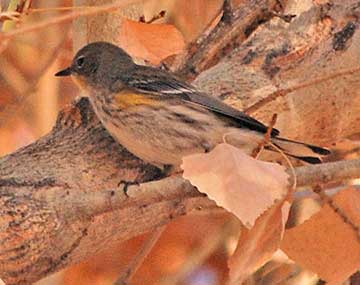
Butterbutt (Yellow-rumped warbler, Audubon's variety)
The mechanics of being "citizen scientists", as Audubon calls us, are simple.  You see a winged shape zip by and you try to identify and tally it.  If it hides, you "pish" and hope it's one of the curious species that responds by popping out to see what the fuss is about.  (Pishing, for you non-birders, is when you go "pwsssssh pwsssssh pwsssssh" repeatedly, which is supposed to be an alarm call or possibly just an annoying noise that birds can't resist.  I was taught as a kid to make a squeaky noise by kissing the back of my hand, and I also resort to that.  
Black-crested Titmouse
Too much pishing is considered harassment, so one must be discriminating.  (And woe to those who use taped bird calls to lure in the target - this adds stress to birds thinking an intruder has arrived and must be fought off.)  Most birds ignore us anyway, so we hope for that one little glimpse to tell us the bird is a black-throated sparrow instead of a white-crowned, or a black-tailed gnatcatcher instead of a blue-gray.  We look for that flash of tail of a soaring bird a quarter mile in the air that tells us it's a red-tailed hawk, and listen for that twitter in the bushes that tells us the bird we never see is a verdin. 
Black Phoebe
I'm amazed at how good some people are at birding.  They have better eyes than mine, and better memories, and can identify quickly a bird I struggle with.  (Oh those pesky sparrows - so many shades of brown!) That's why it's good to bird with others - yes "bird" is a verb - even though it's an activity I often do alone, and find enormously relaxing.


Of course, we all went down to Daniels Ranch to see the illustrious Tufted Flycatcher, but even though we got there minutes after the sun struck the cottonwood trees, only a few people there before us saw it before it went elsewhere.  It did get on the Count, though - woo hoo for Big Bend!  
Looking for the elusive Tufted Flycatcher at RGV- it was shirtsleeves weather a couple hours later
Why do people "bird?"  I guess it's part of the hunting instinct our ancestors needed to survive, ours being the "thrill of the hunt" to find, not to kill.  It also fulfills a need in some of us to "collect" - and many birders have a Life List.  (I won't even mention those who spend tens of thousands of dollars and petroleum products chasing rare birds for their lists.  This may be a type of Obsessive Compulsive Disorder, or maybe just somebody who can afford to do what the rest of us would love to do if we didn't have to pay our bills.)  
Ruby-crowned kinglet showing his ruby
But mostly, I think it's that we appreciate beauty, and birds are indeed beautiful and even mysterious.  They migrate by means even scientists can't fathom, and return to the same bird box the following spring.  Mystery!  Even the piercingly squeaky calls of the starling are, in their own way, marvelous, no matter what one may think of the species itself.  
Rufous-crowned sparrow
I pity the poor souls who are not moved by birds, who do not thrill at the spring song filling a deciduous woodland, or marvel at the glistening colors of a hummingbird.  When I did the people Census in Maine, I noticed a great many people had bird feeders in their yards.  Birdwatching is one of the top hobbies in this country.  In the same way ladies of fashion gave up their hat feathers a century ago to save the egrets who were killed on their nests for their plumage, I think the backyard birder today can be motivated to support conservation measures that will help "their" birds survive.  The Christmas Bird Count is one way to do this.
Black vulture

Friday, December 3, 2010

Sun Dogs and a Sun Pillar

Sun Dog on Right of Sun
 A pair of sun dogs flanked the setting sun this evening, formed by ice crystals in the cirrus clouds.  


I photographed this from the Persimmon Gap Entrance Station where I work, just as I was closing up.   This shows the panorama of their relationship to the sun.

Sun Dog to left of sun
 The red color of each sun dog faces the sun.  

Sun Pillar behind the Corazones at sunset
 A half hour later, a sun pillar decorated the orange clouds of sunset behind the Corazones.

For the technical scoop on this atmospheric phenomenon:

Monday, November 29, 2010

Tufted Flycatcher

I would not have known about this rare bird at Big Bend National Park if a fellow who worked in Southern Florida hadn't come through my entrance station on Friday to tell me he drove 30 hours straight to see it after it was posted on the North American Rare Bird Alert.  It was number 731 or something like that for this young man!  Evidently this is only the third US sighting ever of this Mexican bird, as far as I can tell, and the second for Big Bend - the first was in 1991. 

Other people came looking for this addition to their life lists - from Fort Worth, San Antonio, Louisiana...  There was a rumor that a sharp-shinned hawk might have gotten it (gasp!)  But it was still there this morning, first in the open with sun illuminating its cinnamon breast just before I arrived, and then in the shady cottonwoods immediately across from the Daniels Ranch trailhead at Rio Grande Village.  A young fellow from Louisiana located it around 11 a.m., and the San Antonio fellow came running down the trail (bless his heart!) where I was photographing a vermillion flycatcher to tell me he had a "better bird" for me. 

I was entranced by its antics - it darted after its prey faster than any flycatcher I'd ever seen, making sharp turns and quick forays from its perch, then when landing, without fail, gave several sharp flicks of its tail - more like "vibrating" it.  It had a single and double noted call, very soft, very flycatchery.  I even heard the snap of its beak a couple of times as it snatched a bug in mid-air.  Eastern, black, and Say's phoebes were nearby - the first two in the same tree, and the latter by the river. 

It amazes me that people travel so far to add a bird to their Life Lists.  My own list is probably 300 something birds - it's a very casual list.  I've been a birder since I was 9 years old, but I'm not sure I'd travel 30 hours for a bird that made a wrong turn in its travels and landed in the US.  But I feel very fortunate that I've added another rare bird since being at Big Bend (the first the Colima Warbler) and have spent many blissful hours watching birds here - many of them new for me.

Wednesday, November 24, 2010

River Virgins in Santa Elena


 A poem and photo essay
Deep in Santa Elena Canyon
It finally happened.
My turn on the river,
one of the few here
who has not canoed or rafted or tubed
down the Rio Grande.

In Rock Slide
            Which is not grande.  Not now
            at low water,
            diverted upstream by
            dams and irrigation
to a little creek here
at Lajitas, where we put in.

At "metates"

Me up front in gleaming Number 30,
            also a river virgin,
born in Old Town, Maine.
Bud at stern;
on patrol, John and Elaine
in trusty Number 21.

Tricky spot at Rock Slide
            November. 
No wind, sleeveless,
dipping oars quietly
in the low water
gliding
then “running” the little riffles,
            sometimes hanging on rocks,
            good New Balance shoes (also Maine made) soaked.


Darning needles and mosquito hawks
in tandem flight
joined tail to head in love,
webbed wings a glistening escort.
            Bobcat ears twitched. 
            Mexican horses and cows switched allegiance.

Grinding hole at "metates"
Metates and a coiled fossil
lured us ashore,
            jay-blue sky
rimmed by an ancient white seabed
hugging intrusions from a hidden furnace.


By four-thirty, tents, sleeping pads, the required toilet,
cooler, life jackets, table, chairs, day packs
            and an old tire
found their places ashore
where the river
when swollen and grande,
wipes away the landscape.
            Bud brought little round steaks
            bordered in bacon,
            and vegetables and potatoes
            snuggled in foil.


A little wine (Bud again) and he read
Elaine’s favorite poem by
Robinson Jeffers about the vulture
who thought him dead:

That I was sorry to have disappointed him. To be eaten by that beak
     and
     become part of him, to share those wings and those eyes--
What a sublime end of one's body…

Bud asked, “What makes empires collapse?”
I didn’t have an intelligent answer,
            though I thought I should have. 
The incurious stars, the extravagant ribbon of Milky Way
burn over all empires past and future.  Later,
Orion’s Belt peeked through the tent at several
awakenings,
            panning across my reluctant vision.
Apprehensions about Rock Slide
drove my car into a flash flood
but I found an air bubble and
escaped in my dream
so I was not haunted come morning
when life jackets were zipped.


Rock Slide
Elaine and Bud preparing strategy for maneuvering
 I was on the Penobscot once, in Maine,
rafting with my son and nephew
and two fat ladies,
            oars frantically
            rowing air
            as we sailed over treachery.


But with Bud, who knew what to do,
I think woo-hoo
that was easy,
past Rock Slide and Fern Canyon,
            darting black phoebes, sandpipers rocking,
past a watching hawk, a bufflehead
            and Smuggler’s Cave
            onto a shallow reflecting pool,
waving to hikers
at the mouth with Chisos teeth
to the takeout.


We stopped at Castalon
for a V8 and Klondike bar,
a final ritual
and tribute
to the long-awaited seduction.
                                                           

Wednesday, November 17, 2010

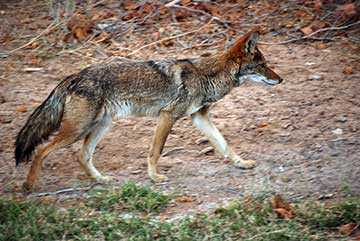
Wile E Coyote


I'm back in Big Bend - will fill you in about the trip, etc. later (after my college classes are over) but I thought I'd just post these photographs of the campground coyote at Rio Grande Village. This guy/gal trotted right through the RV park, and as you can tell, paid me little attention.


Sunday, August 29, 2010

Ninety Miles Around Tahoma - Sept 12

This is the account of my solo backpack trip around Mt. Rainier Sept 1-12, 1990. I will be posting one journal entry each day.


Mt Rainier by Ryan McIntyre

September 12. I am going home.

I hope I am ready.

Eleven miles today and I recall the tortured eleven miles of my second day. Fog muffles sound; the wind does not stir; dew beads on every leaf. My boots are soon soaked. I notice small things now, particularly the profusion of beargrass. I recall baskets I’ve made with cedarbark and dried beargrass; between my fingers the long, narrow leaves are rigid and rough.

I am a bit sad. I do not wish to leave. But I am not a marmot who can hibernate until the snow melts. Nor am I a deer or a hawk or a pipit. I do not belong here any longer. I have accomplished my purpose.

“The hero/ine learns to live in two worlds. This is perhaps the most important teaching of the Vision Quest. One world is sacred, spiritual, eternal. The other world is mortal, material, and subject to change.”

The wet six-mile descent to Mowich River is made in three easy hours. I cross a Jökulhlaups washout, unsure of the trail, and climb uphill through misty forest. I sing. Loudly. “Val-er-eee, val-er-ah, val-er-ah ha ha ha ha ha ha ha haaaaa. Beneath God’s clear blue sky.”

It is a significant moment when I come into the clearing at Mowich Lake, twelve days from the time I left it. I let out an Indian yell. I did it. Tim is not expected until eight, so I have five hours for lunch. The ranger has closed up shop and left hikers’ food caches on the porch. I hope a bear doesn’t get the Alabama guy’s stuff in the cardboard box. Aw, there’s no danger: it’s freeze-dried. Garbage would taste better.

The day is exactly as it was when I began this journey. Foggy.

“The willingness to be a channel of vision takes great courage and endurance and is not lightly assumed. There will be times when you stumble and fall. Then you will want to crawl away to the sacred mountains. These are times of the greatest potential, when you are looking the dragons square in the eye. Only you know what you have hidden away, growing steadily and surely with its magical roots in your subsoil. As you grow, the vision grows. There is no other way.”

I’ve crossed a hundred creeks, counted a million stars, named all the glaciers, wore feathers in my hair. I’ve been to the Garden of Eden and I was created first. And only. I am part of the cosmic consciousness, knowing that I am in God and God is in me, and I am connected to everything else in the universe. I have had the most profound spiritual experience of my life.

I know that I am an original blessing, not an original sin. I know that I am a co-creator with God and his created. I am an artist. A woman. A mother.

And now I go home.


Tim, Cindy and Ryan McIntyre
20 years ago


Ryan McIntyre, age 24, did a backpack trip around Mt. Rainier (Tahoma) with his girlfriend Amy and their friends. Their experience wasn't as idyllic as mine, thanks to a significant snowstorm and much rain. Here is his photo account of that trip in September 2009, 19 years after my own trip. (I'm still waiting for the dramatic journal entries.)


Ninety Miles Around Tahoma - Sept 11

This is the account of my solo backpack trip around Mt. Rainier Sept 1-12, 1990. I will be posting one journal entry each day.


Where the Red Ferns Grow (they weren't really red) Hand-Painted BW photograph

September 11. Eight miles to Golden Lakes.

It is an easy three miles to the North Puyallup River. Corydalis and ferns are plentiful. Here, as in the rest of the park woodlands, is a complete collection of mushrooms and fungi: big beige boletes (edible), fluted cups, retracted anemones, huge orange shelf fungi, Bilbo Baggins toadstools, black leafy things, inky caps, tiny orange umbrella cities, Pillsbury Doughboy pop-ups that break forest duff and jump onto the trail.

An orb spider has ingeniously hung her web high between two trees, anchoring it on the webs of other, more conventional sisters. Sidelit bugs shoot around it like fireworks, but score no direct hit.

A woodland squirrel is displeased with me for the mere fact of my existence. He chitters like a squeeze toy and signs off with rapid staccato, jerking his body out of sight like a wind-up at Pike Place Market.

By early afternoon I enter the silver forest of Sunset Park. This area burned in the 1930s and is now a paradise of bleached trunks, beargrass, and huckleberries. These are my favorite, tall bushes with jumbo black berries that I don’t have to stoop to reach. I wish to see a bear. The sun is warm and the glaciers are farther now.

I am at Golden Lakes camp before I know it. No one is at the ranger cabin but I make a log entry and read about Jökulhlaups and giardia. I abandon thoughts of cross-country camp when the fog comes in suddenly. Soon it is a whiteout. And it’s damp. I gather my things under a tarp and haul out the plastic that is my substitute tent. Its rope is being used to keep food from the mice, so I drape the plastic over the sleeping bag. Soon the world is as wet as if it had rained.